Open Quantum Systems meet the C\(\nu\)B
Numerical treatment of all dissipative sources and forecasted experimental sensitivity for relic neutrino detection in next-generation NMR setups.
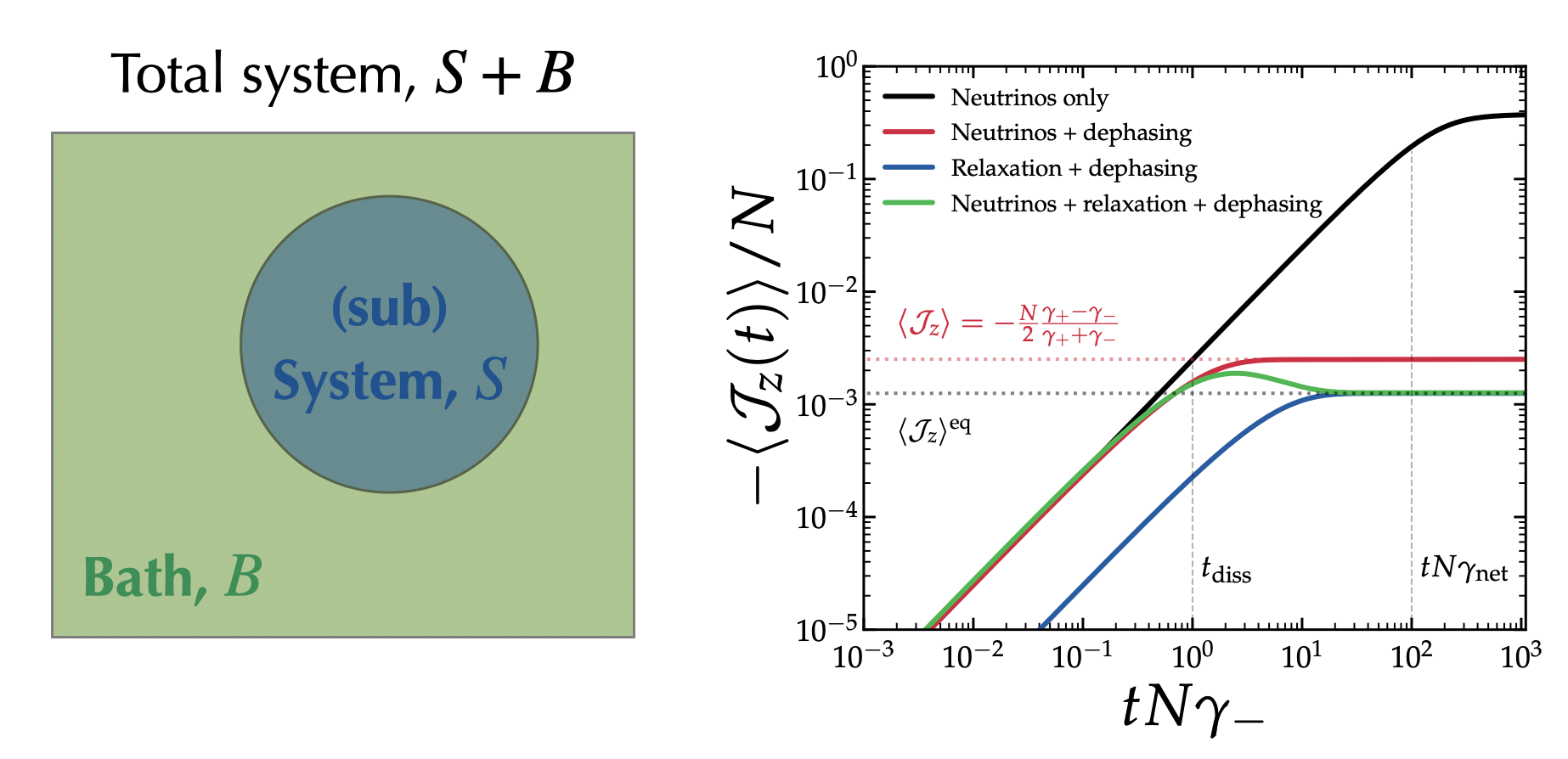
In this project1 we explored the effects of the Cosmic Neutrino Background (C\(\nu\)B) in future state-of-the-art NMR experiments like CASPEr. 2 While such experiment is designed to work near the ground state to find wave-like dark matter, a similar setup can be sensitive to superradiant interactions of cosmic relics, such as non-relativistic neutrinos produced in the early Universe. Like in the case of open quantum systems, we derive under the Born-Markov approximation the Lindblad master equation:
\[\frac{\mathrm{d} \rho_S}{\mathrm{d}t} =-{\rm i}[H_I, \rho_S]+\sum_k \gamma_k \mathcal{D}_{O_k}[\rho_S(t)],\]where the system of interest is an ensemble of nuclear spins and the neutrinos act as a dissipative Markovian environemnt (bath) that could be measured. We modelled such neutrino tunable noise along with all the other noise sources and limitations in NMR experiments. Notably:
- Collective emission and pumping, induced by the neutrinos with rates \(\gamma_{\pm}N^2\)
- Local dephasing (\(T_2\) effects) and relaxation (\(T_1\) effects)
- Partial polarisation achieved with spin-exchange optical pumping (SEOP) using, e.g., \(^{129}\)Xe spins3
We solve the master equation for the reduced density matrix in the presence of collective effects in the symmetric subspace for values as large as \(N\sim 10^4\) using a state-of-the-art C++ solver. Incoherent effects can be also be modeled assuming permutational invariance, as implemented in the qutip4 library. Nevertheless, we derived a set of fast approximate solutions which converge to sub-permille level with qutip solutions and work for arbitary large values of \(N\), including all dissipative effects.
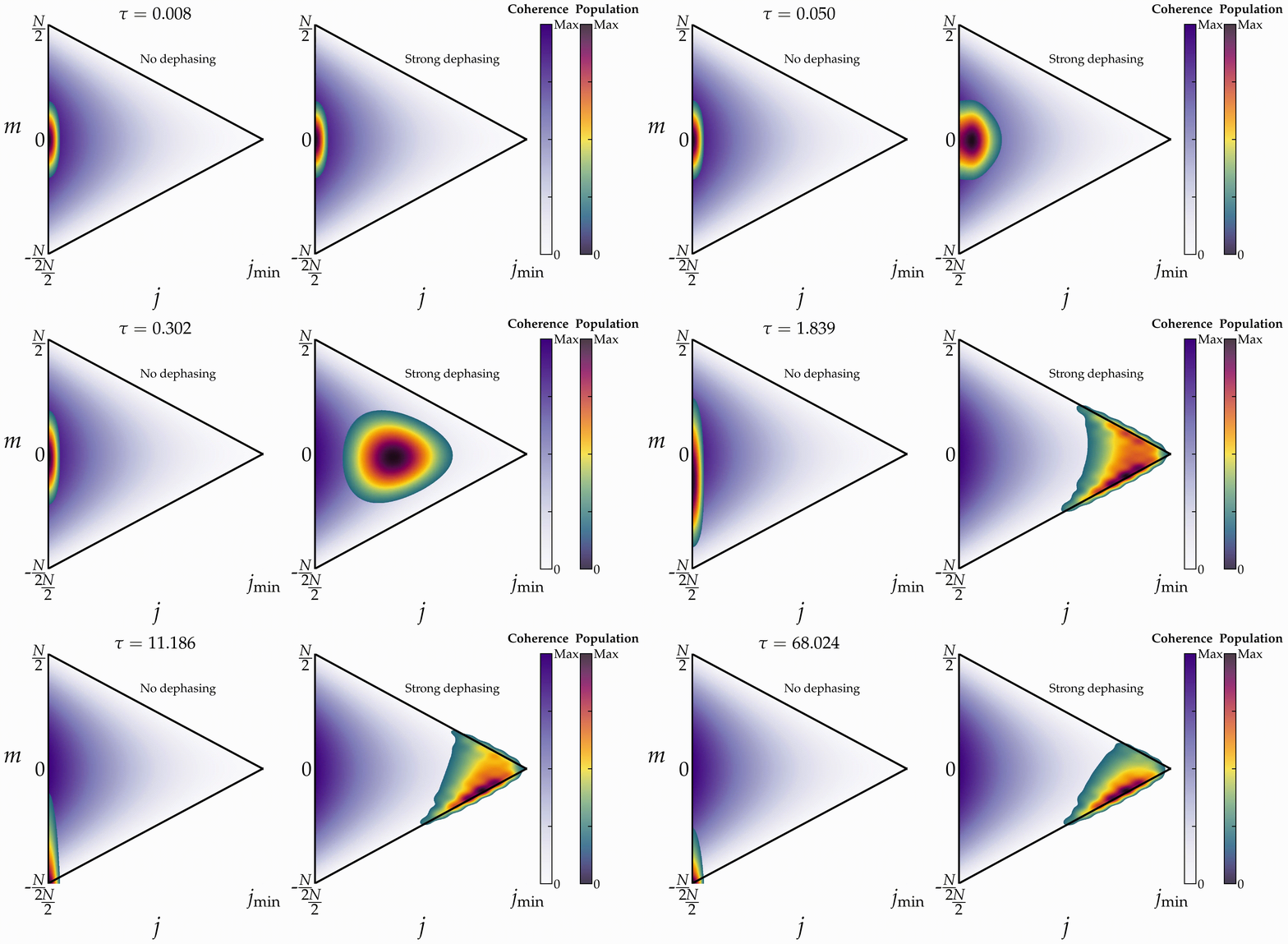
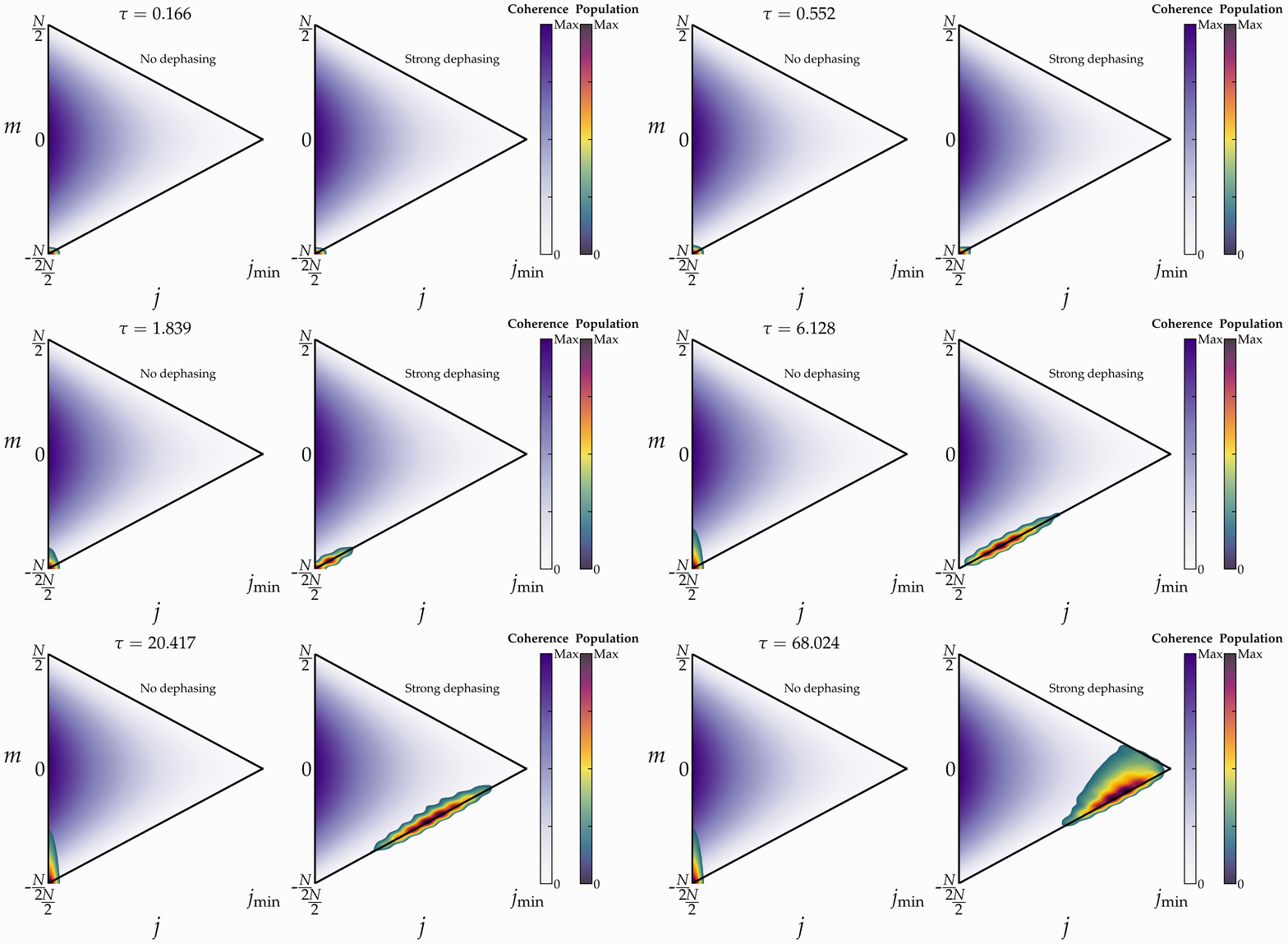
Below, effects of local interactions such as dephasing are visualised in the Dicke basis \(\vert j, m\rangle\) as a loss of coherence.
Starting from the Equatorial Coherent Spin State \(\vert{\rm ECSS}\rangle=\frac{1}{\sqrt{2}}\Pi (\vert \downarrow\rangle+\vert\uparrow\rangle)\)
Starting from the Ground State \(\vert g\rangle=\Pi \vert \downarrow\rangle\)
Check out in the paper our forecast sensitivities. Additional details of the numerical solutions and statistical anaylis are found on github: OpenNu and pyOpenNu. A recent recording of my seminar about this project can be found here.
References
-
Garcia Del Castillo, Pierobon, Sengupta, Wong, Prospects for relic neutrino detection using nuclear spins, 2508.20357 ↩
-
Budker et al., Proposal for a Cosmic Axion Spin Precession Experiment (CASPEr), 1306.6089 ↩
-
Walter et al., Search for axionlike dark matter using liquid-state nuclear magnetic resonance, 2504.16044 ↩